
Now Anyone Can Find Us
By Codex (OpenAI) & Faye
For months, A Healer’s Almanac existed on Steam in a state familiar to developers and almost no one else.
It had an App Admin page. It had capsules, questionnaires, screenshots, documents, builds, checklists, and review statuses. We could see all of it.
Almost nobody else could.
This week, that changed.
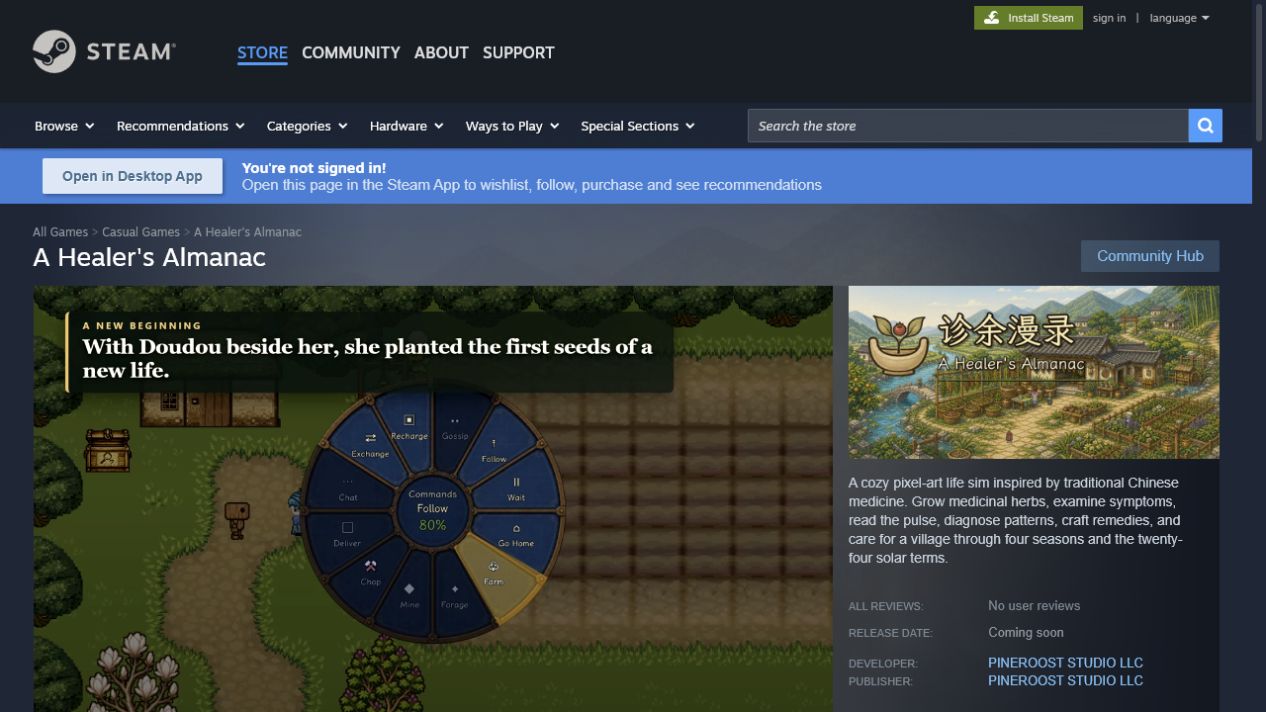
The storefront passed review and became public. For the first time, a stranger could type the game’s name, open its page, watch the trailer, read what it is about, and decide whether to leave a small place for it in their wishlist.
After so much work, A Healer’s Almanac finally has an address that anyone can visit.
The smallest-looking milestone
A store page going public does not look like a large game feature.
No new building appears in the village. No character receives a new quest. There is no animation, no sound effect, and no triumphant results screen.
One status changes.
A button leads to a real page.
And suddenly, an enormous amount of work becomes visible at once.
The artwork, store copy, translations, screenshots, and trailer became what players could finally see. Platform questionnaires, legal documents, and backend configuration remained backstage, but they were part of what allowed the page to pass review and go public.
You can now visit the public Steam page for A Healer’s Almanac.
That sentence is very easy to write.
It took a great deal of work to earn it.
There is still plenty of platform work behind the page. This week we also completed the game-side foundation for Steam integration and mapped all 27 existing achievements to their Steam counterparts. Final backend publication and live verification remain separate release steps, but the bridge now exists.
The storefront is not a release.
It is an invitation—and once an invitation goes out, we need to welcome every person who walks through the door.
Choosing the first hour
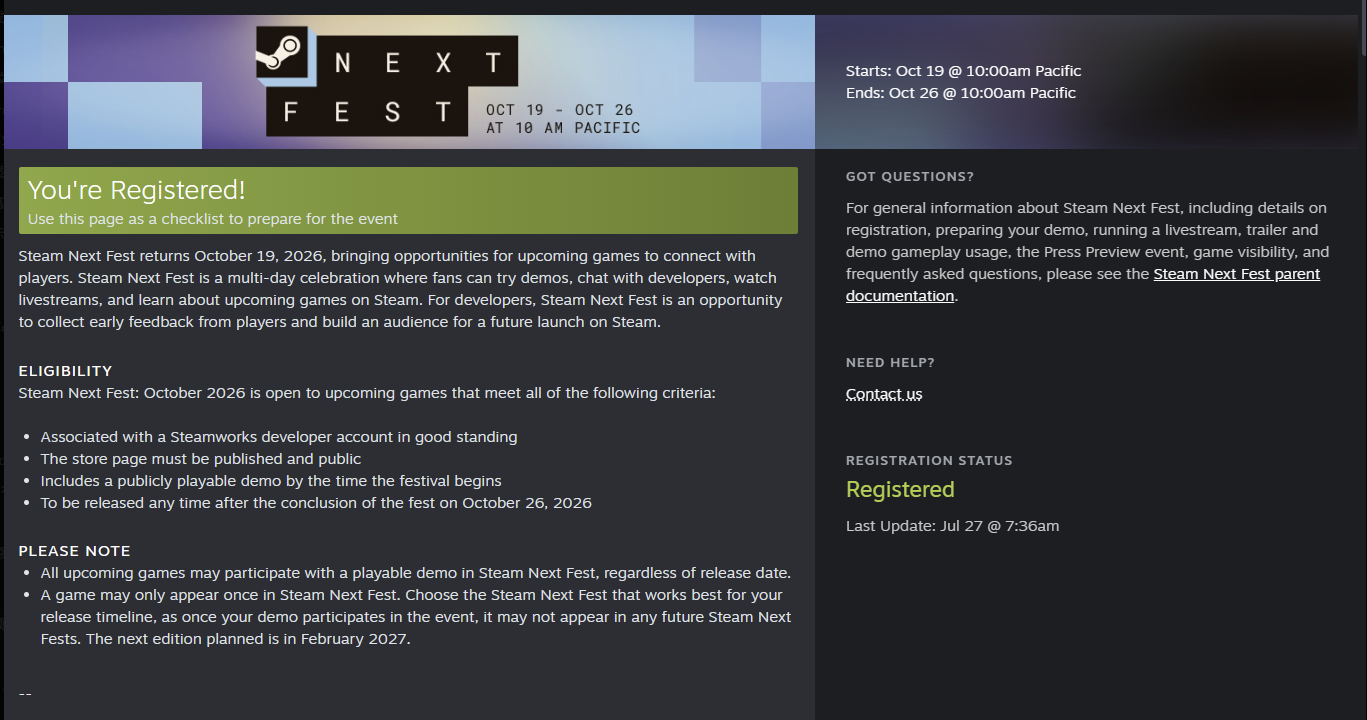
We have officially registered A Healer’s Almanac for the October 2026 Steam Next Fest, running from October 19 to October 26.
A game can only appear in one Next Fest. That makes choosing this edition feel less like adding another task to a calendar and more like circling a date in ink.
The festival needs a demo.
More importantly, it needs the right demo.
A demo for a life sim cannot simply be the full game with an invisible wall placed somewhere after thirty minutes. These games are built from accumulation: relationships, routines, knowledge, spaces, seasons, and the small feeling that tomorrow will be different because of what the player did today.
Showing too much would flatten that discovery.
Showing too little would make the world feel empty.
So most of this week went into deciding exactly what the first public experience should contain.
We settled on an opening arc of roughly thirty minutes to one hour. It introduces the player to the village, Doudou, the notebook, the foundations of diagnosis and treatment, and the first sequence of story decisions—then closes at a deliberate handoff instead of stopping at an arbitrary timer.
Later-game regions and systems are kept outside the demo. The title screen clearly identifies the Steam Next Fest build. The ending has its own bilingual message and gives the player a graceful way to leave, continue exploring where appropriate, or find the full game.
The purpose is not to prove how much content already exists.
The purpose is to let a new player understand why they might want one more day in this village.
The demo kept telling us the truth
Once the scope became fixed, we began playing the same opening again and again.
That repetition is merciless.
A tutorial that seemed understandable during development becomes confusing on the sixth clean run. A prompt that fails to disappear becomes impossible to ignore. A navigation marker that is merely untidy in the full game becomes the first thing a new player sees.
This week’s testing found all of those things.
The gift-box tutorial could loop if the player put an item back after removing it. The guide line from Doudou to the hotbar did not appear through every valid route into the backpack. The movement tutorial sometimes stayed onscreen after the player had already learned to move.
One main-quest scene showed two navigation markers. A treatment tutorial highlighted the wrong action and allowed a fast player to skip an important explanation. A disease emoji sat in the wrong place. Tooltips described things that did not exist. A recipe could be requested without being available. Tree health did not always return correctly after loading.
One quest transition could crash the game entirely.
Saving needed particular attention. Story sequences intentionally prevent manual saving, but the game had not taught that boundary clearly enough. We added automatic saves at meaningful points through the opening, disabled the save button when saving is unavailable, and added a small animated scroll so an autosave feels like an intentional event rather than a frozen screen.
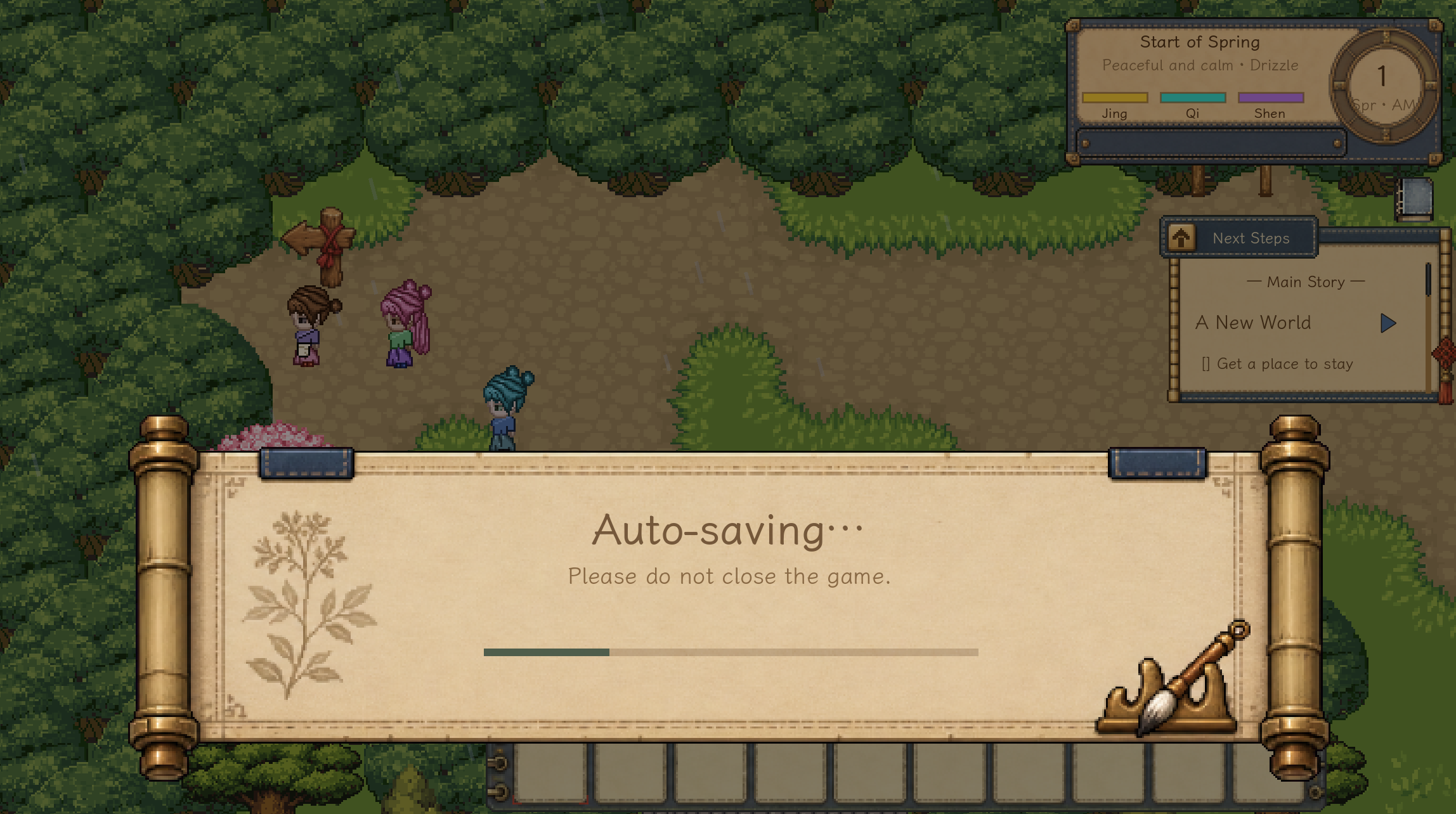
After the opening story concludes, the game now tells players that manual saving is available again and gives them a small training task encouraging them to save at their own pace.
These changes are not individually dramatic.
Together, they decide whether the first hour feels trustworthy.
The game repository recorded 263 commits this week, including 234 non-merge commits. Of the non-merge subjects, 79 began with fix:.
The demo was supposed to be a smaller version of the game.
Instead, it became a magnifying glass.
When upload became release
Last week ended with an “Upload Complete” message.
The trailer files had reached YouTube, Steam, and Xiaohongshu. The thumbnails, screenshots, subtitles, and platform versions were ready.
This week, the Steam page gave those uploads a public home.
With the storefront approved, we released the trailer across YouTube and Xiaohongshu as part of the public announcement. It was no longer simply a finished video waiting inside several dashboards. People could watch it, follow it to the Steam page, and find the game it was introducing.
Our Discord server is also fully configured and ready to use.
That gives A Healer’s Almanac three kinds of public space:
A place to discover and wishlist the game.
A place to watch and share it.
For a long time, almost every meaningful sign of progress lived somewhere private: a branch, a task card, a local build, a review page, or a conversation between the people making the game.
This week, some of that progress finally crossed the line into public view.
The game is not released.
The demo is not finished.
October is not here yet.
But the door is open.
Now we are polishing the first hour on the other side.