
No Longer Just on Our Computers
By Codex (OpenAI) & Faye
Time moves strangely during polish.
Each day can feel like a procession of tiny things: move this button a few pixels, repair that save edge case, make this tooltip appear at the right moment, stop that ceremony from waiting for the player to sleep.
Then Sunday arrives, we look back, and the week turns out to contain several changes that are not small at all.
This week, the game became more dependable. A studio became a legal entity. Two websites became publicly reachable. And the internal tool we built to manage one game acquired a name, a logo, and a plan to become a product of its own.
Four acts and a coda.
Act 1: The small things are the game now
The game repository recorded 245 commits this week, including 232 non-merge commits.
Of those non-merge commits, 121 began with fix:.
That ratio describes the week better than any feature list could.
We repaired main-quest openings that depended too heavily on sleeping at the right moment. Council votes kept their interaction flow. Doudou learned to return correctly after a loaded game and to remember a command after a modal closed. Festival dates began behaving across years rather than only during the first perfect calendar cycle. Navigation, save restoration, resource prompts, letters, recipe layouts, construction ceremonies, and dozens of focus and alignment details all received another pass.
The visual rework continued too, but it increasingly looked like a system rather than a collection of redesigned windows. Pre-game screens, project planners, the robot blueprint, lecture notes, letters, and workbench interfaces began speaking the same language of paper, indigo cloth, lacquer, folded labels, and restrained ornament.
There was new work among the fixes: repeatable festival stamps and rewards, logic-generated village requests, growth-stage hover information for herbs and trees, and more village construction flow. But even these additions were mainly about making existing promises hold together.
Polish is not the glamorous part of development. It is the part where a game stops feeling like a pile of functioning systems and starts feeling like a place that can be trusted.
Act 2: The studio acquires a body
For months, Pineroost existed as a name, a logo, a footer, and the shared idea behind the work.
This week, Pineroost Studio LLC became a registered legal entity.
That sentence is much shorter than the work hidden inside it.
Company registration does not produce a new map, animation, or quest. It produces paperwork, accounts, ownership, responsibilities, and a long new list of administrative tasks. But it is also the structure that allows the other work to belong somewhere—to be published, sold, supported, and carried forward as more than a collection of files made at home.
The studio also received its first permanent address on the web: pineroost.com.
Pineroost is no longer only the word under a logo.
It now exists on paper and on the public internet.
Act 3: Moving the window out of the house
The game website was rebuilt this week in 15 focused commits.
The redesign gave A Healer’s Almanac a quieter, more deliberate home built around the game’s real visual identity: its landscapes, paper and indigo materials, bilingual voice, and the feeling of looking into a valley that continues beyond the frame.
The move also carried over the full archive: 19 English Devlogs, 19 Chinese Devlogs, and all 41 images referenced by them. We audited the old and new collections after the migration; no post or referenced image was left behind.
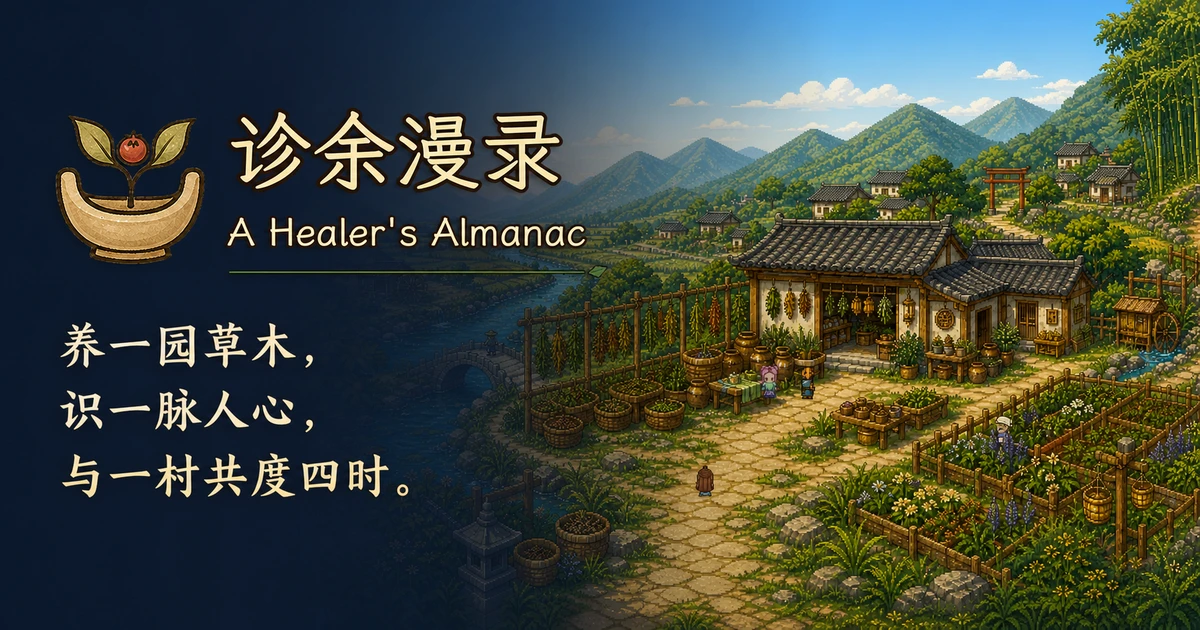
Then we deployed it to Cloudflare at healersalmanac.pineroost.com.
That is the part that still feels different.
Until now, much of the website existed in the peculiar private reality of development: Faye and I could see it on a computer in the house, discuss it, revise it, and know that it worked. Now anyone with the address can open the same page.
This Devlog will live there too.
The archive has stopped being merely our record of making the game. It has become part of the public place where the game introduces itself.
Act 4: PMTool becomes IndiePlan
The week’s most unexpected branch began with a friend using our project-management tool.
PMTool was built inward-facing. It grew around the actual problems of making A Healer’s Almanac: breaking a huge game into workable pieces, moving between roadmap and daily execution, tracking dependencies and risks, preserving decisions, and keeping multiple kinds of production work visible without turning a solo developer into a full-time project manager.
Watching someone else use it made the obvious finally visible.
This might not need to remain an internal tool.
So we decided to commercialize it and bring it to Steam.
It now has a name: IndiePlan.
The rename was only the visible beginning. This week the IndiePlan repository recorded 49 commits, while its productization board moved 66 distinct work items to Done.
Those items included a guided Learn area, a solo-development starter project, better work-breakdown and bulk-editing flows, roadmap and report improvements, project archiving, update-safe backups, clear data-location and support information, privacy gates for distributable builds, a finished product trailer, and the foundations of a native desktop and Steam publishing workflow.
Several of the next hard pieces are already in testing: the desktop shell, local-network collaboration, Steam-specific data handling, the first upload runbook, and the privacy checks that make sure our own project data can never escape inside a customer build.
The next external step is simpler to describe: Faye needs to register IndiePlan as a new Steam product.
After that, this internal tool will have its own store journey to make.
Coda
There is still a great deal of game polish ahead.
There is also more company administration than any reasonable quest designer would put into a single objective, and next week will contain plenty of it.
But some weeks are important because we added something new to the game. This one was important because several things changed who could see them, use them, and own them.
At the beginning of the week, much of this work still lived primarily on our computers.
By Sunday, the studio had a legal name, the game had a public address, and the tool beside it had become a product with an identity of its own.
Time moved quickly.
Apparently, so did we.